
Stellarators Revived as a Viable Path to Commercial Fusion Energy
Stellarators — once sidelined in favour of tokamaks — are attracting renewed scientific and commercial interest as a potentially more stable route to practical fusion power. Their complexity, long seen as a fatal flaw, may now be an engineering problem that modern computing can solve.
Explanation
Nuclear fusion is the process that powers the sun: smashing light atomic nuclei together to release enormous amounts of energy. For decades, scientists have been trying to replicate it on Earth as a source of clean, virtually limitless electricity. The challenge is keeping superheated plasma — a gas so hot that electrons are stripped from atoms — confined long enough for fusion reactions to sustain themselves.
The dominant approach has been the **tokamak**, a doughnut-shaped magnetic cage that holds plasma using a combination of external magnets and an electrical current driven through the plasma itself. Tokamaks have produced record-breaking results, including at the JET facility in the UK and the under-construction ITER project in France. But that internal current is a liability: it can suddenly collapse in events called "disruptions," potentially damaging the reactor.
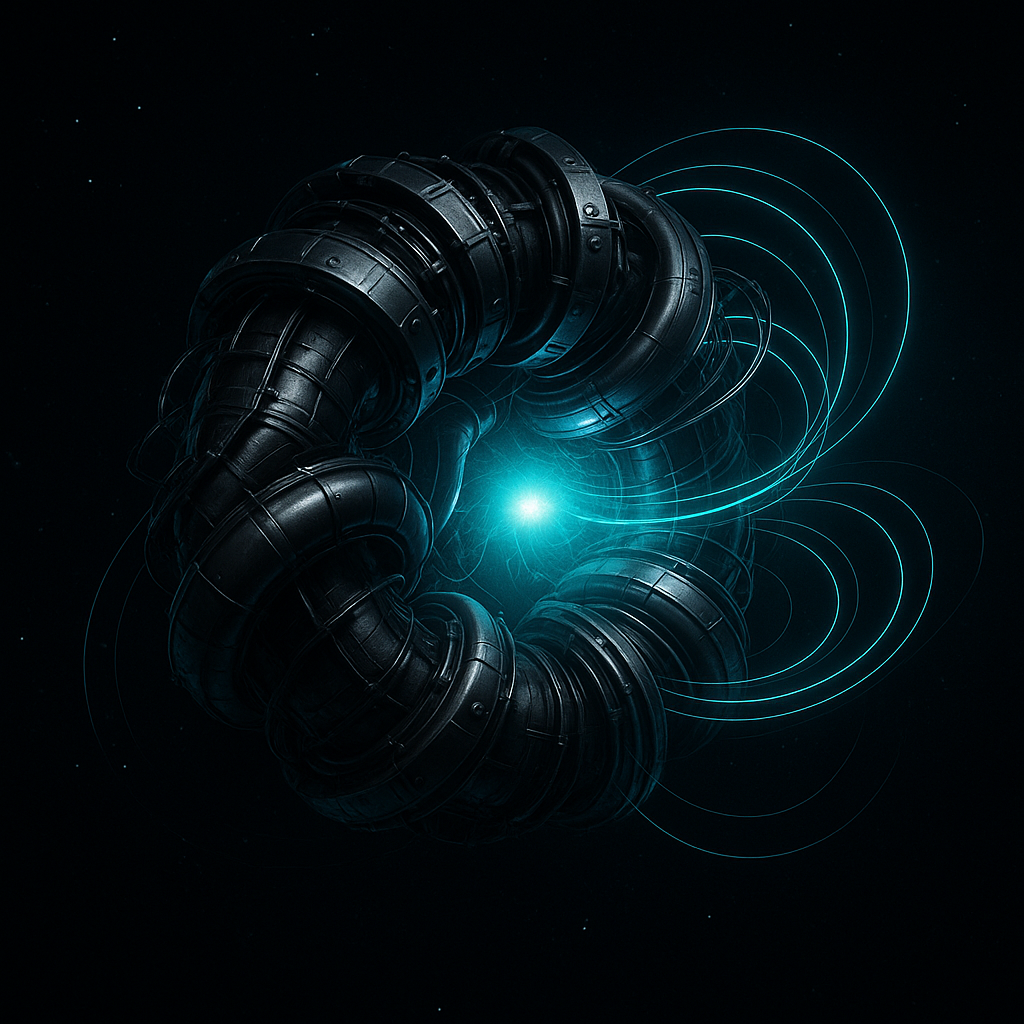
A **stellarator** takes a different philosophy. It relies entirely on external, twisted magnetic coils to confine the plasma — no internal current required. This makes the plasma inherently steadier and, in principle, able to run continuously rather than in pulses. The catch is that the coil geometry is extraordinarily complex: the shapes required to produce a stable magnetic field look almost impossibly convoluted.
For most of the 20th century, that complexity made stellarators impractical. But modern supercomputers can now optimise coil designs with a precision that was unthinkable a generation ago. Germany's Wendelstein 7-X, the world's largest stellarator, has demonstrated record plasma performance and confirmed that computer-optimised designs work as predicted. Several private companies are now betting on the concept.
It is worth tempering expectations: no fusion device — stellarator or tokamak — has yet achieved net energy gain in a commercially meaningful sense. The stellarator renaissance is real, but it remains early-stage. The path from promising plasma physics to a power plant delivering electricity to the grid involves enormous engineering, materials, and economic hurdles that could take decades to clear.
Stellarators and tokamaks both use magnetic confinement to achieve the plasma conditions needed for deuterium-tritium (or alternative fuel cycle) fusion, but they differ fundamentally in how that confinement is generated. Tokamaks induce a toroidal plasma current via transformer action, which contributes a poloidal magnetic field component essential for equilibrium. This current enables disruptions — rapid, uncontrolled terminations of the plasma that can deposit gigajoules of energy on first-wall components in milliseconds, a critical engineering risk for reactor-scale devices. Stellarators eliminate the driven current entirely; all necessary field components are produced by external coils whose geometry encodes the required rotational transform. The plasma is therefore intrinsically disruption-free and capable of steady-state operation, both highly desirable reactor qualities.
The historical penalty was severe: the non-planar, three-dimensionally shaped coils required for an optimised stellarator are analytically intractable and were practically unbuildable before the era of high-fidelity numerical optimisation. Early stellarators (Princeton's Model C, for instance) underperformed badly relative to contemporary tokamaks, and the concept was largely deprioritised after the 1970s. The revival began with the theoretical framework of **neoclassical transport optimisation** — designing the magnetic geometry so that particle drift orbits close on themselves, suppressing the anomalous energy losses that plagued classical stellarators.
Wendelstein 7-X (W7-X) at the Max Planck Institute for Plasma Physics in Greifswald, Germany, is the proof-of-concept for this optimisation paradigm. Its 50 non-planar superconducting coils were manufactured to millimetre tolerances and assembled over more than a decade. Since beginning operations in 2015, W7-X has achieved plasma stored energies and confinement times that match or approach equivalent tokamak performance, validating the optimisation codes. A 2021 campaign demonstrated record ion temperatures exceeding 10 keV and energy confinement times consistent with reactor-relevant scaling — incremental but significant milestones.
On the private side, companies including **Type One Energy** (US), **Renaissance Fusion** (France/EU), and **Proxima Fusion** (Germany, a Max Planck spin-out) are pursuing stellarator-based commercial reactors, leveraging high-temperature superconducting (HTS) tape to build stronger, more compact magnets — the same material advantage that has accelerated tokamak ventures like Commonwealth Fusion Systems. HTS magnets operating at ~20 T fields could allow stellarator plasma volumes to shrink dramatically, potentially compressing development timelines.
Key open questions remain substantial. Stellarator optimisation codes are validated at W7-X scale but extrapolation to reactor-grade plasmas (higher beta — the ratio of plasma pressure to magnetic pressure — and alpha-particle heating) is unproven. Turbulent transport, which dominates at high temperatures, is not fully captured by neoclassical optimisation alone; gyrokinetic simulations suggest residual turbulence could still limit performance. The complex coil geometry also raises manufacturing cost and reproducibility concerns at commercial scale. A falsifying result would be W7-X or a successor device showing confinement that degrades faster than neoclassical predictions as plasma pressure increases, or HTS coil technology failing to deliver the field strengths needed for compact geometries. Neither has occurred, but neither has been tested at full reactor parameters.
Reality meter
Time horizon
Community read
Glossary
- magnetic confinement
- A method of containing plasma using strong magnetic fields that trap charged particles in curved orbits, preventing them from escaping and cooling the fuel needed for fusion reactions.
- poloidal magnetic field
- A component of the magnetic field that circles around the minor circumference of a toroidal (doughnut-shaped) plasma, working together with the toroidal field to confine particles.
- rotational transform
- A measure of how much the magnetic field lines twist around the plasma as you move from the center outward, essential for plasma stability and confinement in stellarators.
- neoclassical transport optimisation
- The design of magnetic geometry to minimize particle energy losses by ensuring that charged particles' drift orbits close on themselves rather than carrying energy away from the plasma.
- beta
- The ratio of plasma pressure to magnetic pressure; a key measure of how efficiently a fusion device uses its magnetic field to confine hot plasma.
- gyrokinetic simulations
- Advanced computer models that track how charged particles gyrate (spiral) around magnetic field lines while drifting, used to predict turbulent transport and energy losses in plasma.
Sources
No sources on file.
Prediction
Will a stellarator-based fusion device demonstrate net energy gain (Q > 1) before 2040?