
NAD+ Mapped Across All 14 Hallmarks of Aging
If a single molecule touches every known mechanism of biological aging, it either deserves serious attention or serious skepticism. NAD+ is now being mapped to all 14 hallmarks — and the case is less hype than it looks.
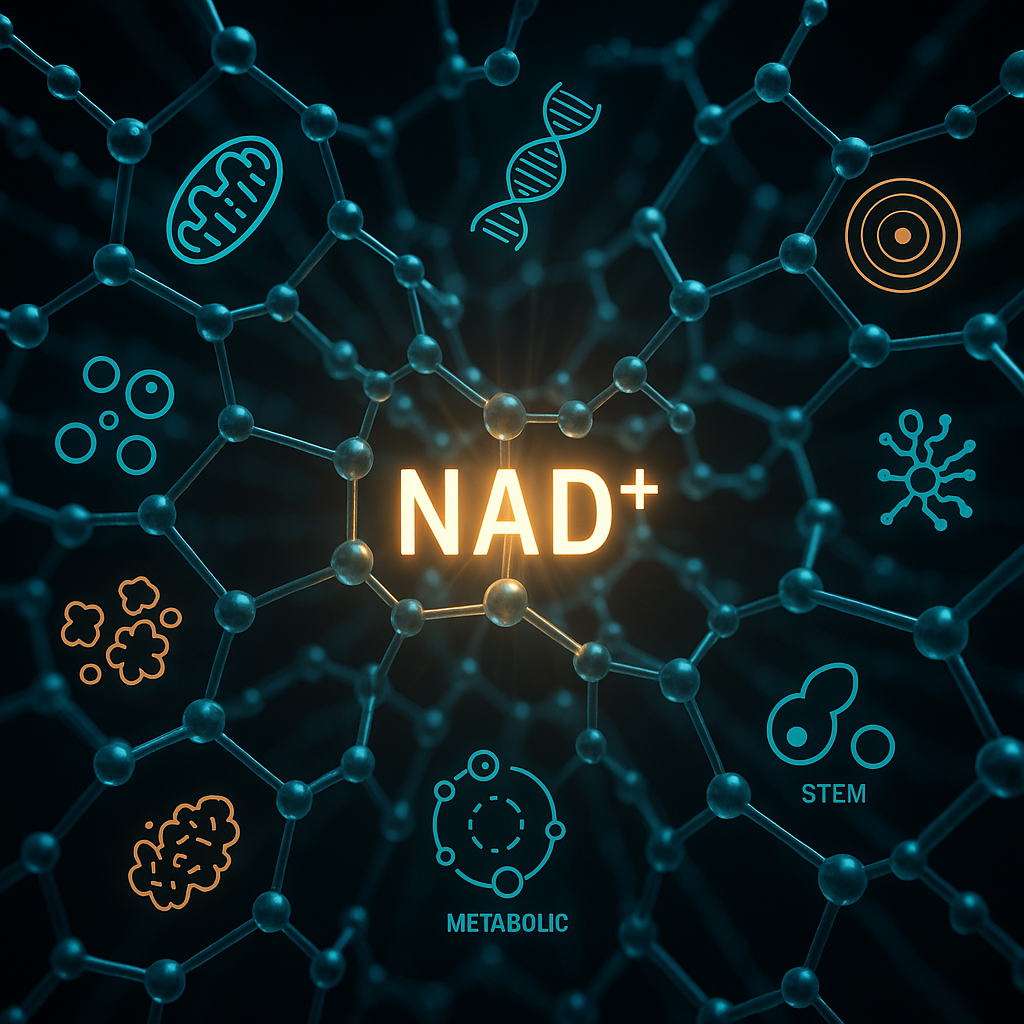
Explanation
The "hallmarks of aging" are a scientific framework — originally 9, now expanded to 14 — that catalogs the core biological processes that break down as we get older. Think of them as the root causes behind wrinkles, cognitive decline, and disease risk: things like DNA damage accumulating, cells losing their identity, mitochondria (the cell's power plants) becoming dysfunctional, and the immune system misfiring.
NAD+ (nicotinamide adenine dinucleotide) is a coenzyme — a helper molecule — found in every cell. It's essential for energy metabolism, but it also activates a class of proteins called sirtuins, which act as cellular maintenance crews. The problem: NAD+ levels drop significantly with age, roughly 50% by middle age in some tissues.
What's new here is the systematic attempt to connect NAD+ decline not just to a few aging pathways, but to all 14 hallmarks — including newer additions like chronic inflammation ("inflammaging"), loss of cellular communication, and disabled autophagy (the cell's self-cleaning process). The argument is that NAD+ isn't just one lever among many; it's closer to a master regulator sitting upstream of most of the others.
Why does this matter today? Because NAD+ precursors — NMN and NR — are already widely sold as supplements, and clinical trials are underway. If the 14-hallmark framing holds up under scrutiny, it strengthens the rationale for targeting NAD+ as a longevity intervention rather than a niche metabolic fix. It also raises the stakes for ongoing trials: a molecule this central failing to show broad benefit would be a significant falsifier for the whole NAD+ hypothesis.
The caveat worth naming: this type of review can overfit a narrative. Touching a hallmark is not the same as meaningfully reversing it. Watch for human trial data, not just mechanistic maps.
The Lopez-Otin hallmarks framework — expanded from 9 to 14 in its 2023 Cell update — now includes genomic instability, telomere attrition, epigenetic alterations, loss of proteostasis, disabled macroautophagy, deregulated nutrient sensing, mitochondrial dysfunction, cellular senescence, stem cell exhaustion, altered intercellular communication, chronic inflammation, and dysbiosis, among others. Mapping NAD+ across all 14 is an ambitious claim that deserves mechanistic scrutiny.
The strongest links are well-established: NAD+ is the obligate substrate for PARP1/2-mediated DNA repair (genomic instability), the sirtuin deacylases SIRT1/3/6 (epigenetic regulation, mitochondrial biogenesis, metabolic sensing), and CD38/NNMT-driven NAD+ consumption that accelerates with age and inflammation. SIRT1 and SIRT6 directly modulate heterochromatin maintenance and transposable element silencing — connecting NAD+ to epigenetic drift in a mechanistically specific way.
The weaker links — dysbiosis, altered intercellular communication, stem cell exhaustion — rely on more indirect chains: NAD+-dependent regulation of inflammatory cytokines (via SIRT1 suppression of NF-κB), or NAD+ repletion studies in aged mice showing partial restoration of muscle stem cell function. These are real signals, but the effect sizes in humans remain poorly characterized.
The competitive landscape matters here. NMN and NR trials (Elysium, ChromaDex, Washington University cohorts) have shown modest but real improvements in NAD+ tissue levels in humans. The translation to functional outcomes — insulin sensitivity, muscle performance, cognitive metrics — is inconsistent across trials, likely due to tissue bioavailability differences and dosing heterogeneity.
The 14-hallmark framing is useful as a hypothesis-organizing tool, but risks becoming a post-hoc narrative if not paired with intervention data that tests hallmark-specific endpoints. The key falsifier: a well-powered NMN/NR trial with multi-hallmark biomarker panels (epigenetic clocks, senescence markers, mitochondrial function) that shows NAD+ repletion moves fewer than expected. That data is largely still missing. What to watch: results from the XPRIZE Healthspan trials and NIA-funded aging intervention studies expected 2025–2026.
Reality meter
Time horizon
Community read
Glossary
- NAD+
- Nicotinamide adenine dinucleotide (oxidized form), a coenzyme found in all living cells that plays a central role in energy metabolism and serves as a substrate for enzymes involved in DNA repair, aging, and cellular stress responses.
- PARP1/2
- Poly(ADP-ribose) polymerase enzymes that use NAD+ as a substrate to repair DNA damage by adding ADP-ribose groups to damaged DNA and associated proteins.
- Sirtuins (SIRT1/3/6)
- A family of NAD+-dependent deacetylase and deacylase enzymes that regulate cellular processes including metabolism, stress resistance, and epigenetic modifications.
- Epigenetic alterations
- Changes in chemical modifications to DNA and histone proteins that affect gene expression without altering the underlying DNA sequence itself.
- Proteostasis
- The cellular system that maintains proper protein folding, synthesis, and degradation to ensure proteins function correctly and prevent accumulation of misfolded proteins.
- Macroautophagy
- A cellular recycling process where cells engulf and digest damaged organelles and proteins in double-membrane vesicles called autophagosomes.
- Dysbiosis
- An imbalance in the composition and function of the microbial community (microbiome), typically referring to harmful changes in gut bacteria that can affect health.
Sources
- Tier 3 The 14 Hallmarks of Aging: How NAD+ Plays a Role in Every Hallmark
- Tier 3 Longevity Science Is Overhyped. But This Research Really Could Change Humanity.
- Tier 3 11 Rising Stars Shaping the Future of Longevity - Business Insider
- Tier 3 A cheap drug used by longevity enthusiasts may have a surprising impact on exercise
- Tier 3 Scientists boost lifespan by 70% in elderly male mice using simple drug combo | ScienceDaily
- Tier 3 Next gen cancer drug shows surprising anti aging power | ScienceDaily
- Tier 3 The Future of Longevity: Innovations in Aging Research - IMJ Health Blog
- Tier 3 A long and ongoing look at the secrets of human longevity and healthy aging | ScienceDaily
- Tier 3 Healthy Aging News -- ScienceDaily
- Tier 3 Amid the Hype, Longevity Science Shows Some Progress – HotAir
- Tier 3 It’s never too late: Just moving more could add years to your life | ScienceDaily
- Tier 3 This method to reverse cellular aging is about to be tested in humans | Scientific American
- Tier 1 This method to reverse cellular ageing is about to be tested in humans
- Tier 3 Timeline of aging research - Wikipedia
- Tier 3 A hidden cellular cleanup trick could reverse aging | ScienceDaily
- Tier 3 Scientists may have found how to reverse memory loss in aging brains | ScienceDaily
- Tier 3 Scientists reversed brain aging and memory loss in mice | ScienceDaily
- Tier 3 New nasal spray reverses brain aging while restoring memory, giving new hope to people with dementia
- Tier 1 Daily briefing: A treatment to reverse cellular ageing is about to be tested in people
- Tier 3 Brain Research breakthrough: Nasal Spray Reverses Aging Effects
- Tier 3 Life Extension Treatments: A New Era in Anti-Aging (2026)
- Tier 3 Clinical trial for Longevity drug meets goal of enrolling 1000 dogs | dvm360
- Tier 3 Home lifespan | Lifespan Research Institute
- Tier 3 FDA determines drug for lifespan extension in large dogs to have a Reasonable Expectation of Effectiveness | dvm360
- Tier 3 Second drug for canine healthy lifespan extension receives FDA support | dvm360
- Tier 3 Seragon Publishes Record-Breaking SRN-901 Longevity Data, Demonstrating 33% Lifespan Extension in Mice
- Tier 3 Scientists bet on longevity to unlock a longer lifespan for humans | MEXC News
- Tier 3 Can aging be slowed? Some academic scientists think so | AAMC
- Tier 3 Reconsidering GLYNAC: What the Evidence Actually Says About Glycine, NAC, Reversing Aging, and Life Extension - New Life Longevity
- Tier 3 dsm-firmenich unveils science-backed longevity innovations at Vitafoods Europe 2026
- Tier 3 Serum protein profiling reveals hallmark-level aging trajectories and strain-specific resilience in CB6F1J and C57BL/6J male mice | bioRxiv
- Tier 1 Cardiovascular ageing: hallmarks, signaling pathways, diseases and therapeutic targets | Signal Transduction and Targeted Therapy
- Tier 3 Organelle resilience as a comparative blueprint for longevity | EMBO Molecular Medicine | Springer Nature Link
- Tier 3 The Hallmarks of Aging and Senescence
- Tier 3 Peer-Reviewed Aging Research Journal | Aging-US
- Tier 3 The Hallmarks of Aging
- Tier 3 Blue zone - Wikipedia
- Tier 3 Home - Live Better, Longer - Blue Zones
- Tier 3 Origins of the Blue Zones and Longevity Secrets - Blue Zones Project
- Tier 3 Blue Zones longevity claims may rest on flawed records, essay argues
- Tier 3 Are Blue Zones Debunked? - by Sarah Ballantyne, PhD
- Tier 3 How people in Blue Zones live longer, and the 5 habits ...
- Tier 3 Lessons from Blue Zones: Diet & Lifestyle for Longevity
- Tier 3 Are Blue Zones Real? A New Scientific Definition for Longevity Hotspots Could Be a Game Changer.
- Tier 3 Scientists set a formal definition for "Blue Zones" | EurekAlert!
- Tier 3 Blue zones: New rules define where people truly live the longest - Earth.com
Prediction
Will a large-scale human clinical trial by end of 2026 demonstrate that NAD+ precursor supplementation measurably improves biomarkers across at least 5 of the 14 hallmarks of aging?
Vote
Your vote feeds topic weights, community direction and future prioritisation. Open community direction