
Aging Is Not One Process — It's a Measurable Stack of Failures
Aging isn't entropy — it's a specific, layered set of cellular breakdowns that can now be tracked in real time. That distinction matters because what's measurable is, in principle, addressable.
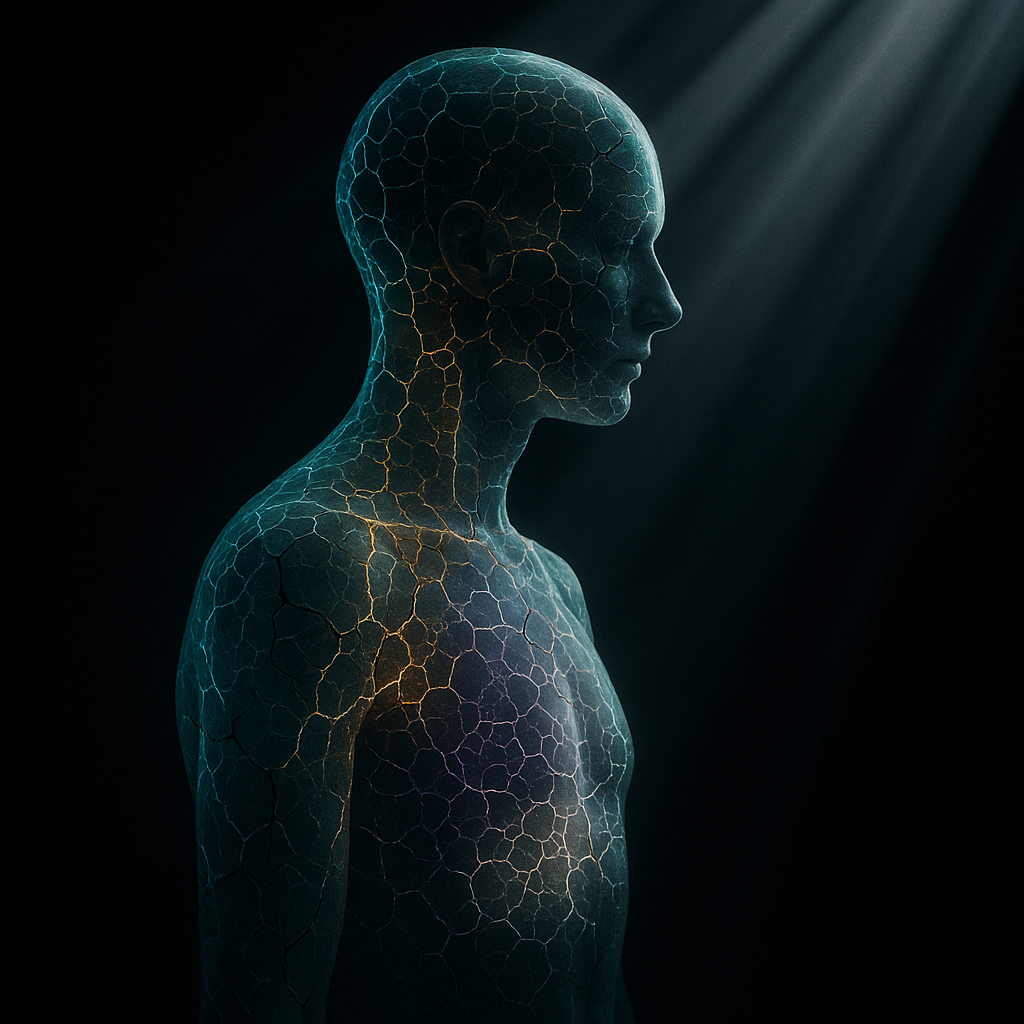
Explanation
For most of human history, aging was treated as a single, vague force — time doing its thing. The emerging biological picture is far more precise: aging is a collection of distinct molecular processes that compound on each other, not one unified decline.
Think of it like a building that doesn't just "get old" — it has a leaking roof that warps the floors, which strains the foundation, which cracks the walls. Each failure is specific. Each has a cause. And crucially, each can be measured.
The key shift here is from aging as fate to aging as a diagnostic problem. Researchers have identified several core "hallmarks" — things like DNA damage accumulation, dysfunctional mitochondria (the cell's power generators), senescent cells (old cells that stop working but refuse to die and inflame surrounding tissue), and the shortening of telomeres (protective caps on chromosomes). These aren't metaphors. They're measurable biological states.
Why does this matter today? Because consumer-grade and clinical tools are now reaching the point where individuals can get a real-time snapshot of where their biology sits relative to their chronological age. That gap — between how old your passport says you are and how old your cells are behaving — is increasingly the number that actually predicts health outcomes.
The practical upshot: if you can measure it, you can potentially intervene earlier, target specifically, and track whether interventions are working. The era of "eat well and hope for the best" is giving way to something more like metabolic debugging. Whether that translates into meaningfully longer healthspans at scale is still an open question — but the framing has permanently changed.
The conceptual reframe here is significant: aging research has moved from geroscience as a philosophical curiosity to a mechanistic, multi-pathway discipline with clinical traction. The canonical framework — Lopez-Otin et al.'s hallmarks of aging, now expanded to twelve in the 2023 update — gives researchers and, increasingly, clinicians a structured vocabulary for what's actually failing and when.
The core mechanisms in play: genomic instability and telomere attrition drive replication errors and senescence entry; epigenetic drift (measurable via methylation clocks like Horvath's or DunedinPACE) decouples biological from chronological age with surprising predictive power for all-cause mortality; mitochondrial dysfunction cascades into NAD+ depletion, which impairs sirtuin-mediated repair; and the senescence-associated secretory phenotype (SASP) creates a chronic low-grade inflammatory environment — "inflammaging" — that accelerates adjacent tissue degradation.
What's new isn't the hallmarks themselves but the convergence of measurement infrastructure around them. Biological age clocks, proteomics panels (notably Levine's PhenoAge and the SomaLogic-based plasma protein clocks), and continuous metabolic monitoring are moving from research tools to accessible diagnostics. This creates a feedback loop that didn't exist before: intervention → measurement → adjustment.
The open questions are non-trivial. Most longevity interventions with strong mechanistic rationale (senolytics, NAD+ precursors, rapamycin analogs) still lack large-scale RCT data in humans. Surrogate endpoints — a better methylation clock score — may not map cleanly onto hard outcomes like cardiovascular events or cognitive preservation. And the compounding nature of the hallmarks means single-target interventions may hit diminishing returns fast.
What would change the picture: a randomized trial showing that a measurable reduction in biological age (by any validated clock) correlates with reduced all-cause mortality over a 10+ year horizon. Until then, the field is operating on strong mechanistic logic and promising but incomplete evidence. Watch the TAME trial (metformin, aging as indication) and emerging senolytics data from Unity Biotechnology as near-term signal generators.
Reality meter
Time horizon
Community read
Glossary
- epigenetic drift
- Changes in chemical modifications to DNA (such as methylation) that accumulate over time and can alter gene expression without changing the DNA sequence itself. It can be measured by biological age clocks and is predictive of mortality risk.
- senescence-associated secretory phenotype (SASP)
- A state where aging cells release inflammatory molecules and other factors that damage surrounding tissues, creating chronic low-grade inflammation known as inflammaging.
- NAD+ depletion
- A decline in nicotinamide adenine dinucleotide (NAD+), a critical molecule in cells that supports energy production and repair processes, particularly those mediated by proteins called sirtuins.
- senolytics
- Drugs or compounds designed to selectively eliminate senescent cells—aged cells that have stopped dividing but accumulate in tissues and contribute to aging and disease.
- surrogate endpoints
- Measurable markers (such as improved biological age clock scores) used in clinical trials as stand-ins for direct health outcomes, though they may not always predict real-world benefits like disease prevention.
- genomic instability
- Accumulation of errors and damage in DNA over time, leading to mutations and impaired cellular function, which is a fundamental driver of aging.
Sources
- Tier 3 Superpower
- Tier 3 Longevity Science Is Overhyped. But This Research Really Could Change Humanity.
- Tier 3 11 Rising Stars Shaping the Future of Longevity - Business Insider
- Tier 3 A cheap drug used by longevity enthusiasts may have a surprising impact on exercise
- Tier 3 Scientists boost lifespan by 70% in elderly male mice using simple drug combo | ScienceDaily
- Tier 3 Next gen cancer drug shows surprising anti aging power | ScienceDaily
- Tier 3 The Future of Longevity: Innovations in Aging Research - IMJ Health Blog
- Tier 3 A long and ongoing look at the secrets of human longevity and healthy aging | ScienceDaily
- Tier 3 Healthy Aging News -- ScienceDaily
- Tier 3 Amid the Hype, Longevity Science Shows Some Progress – HotAir
- Tier 3 It’s never too late: Just moving more could add years to your life | ScienceDaily
- Tier 3 This method to reverse cellular aging is about to be tested in humans | Scientific American
- Tier 1 This method to reverse cellular ageing is about to be tested in humans
- Tier 3 Timeline of aging research - Wikipedia
- Tier 3 A hidden cellular cleanup trick could reverse aging | ScienceDaily
- Tier 3 Scientists may have found how to reverse memory loss in aging brains | ScienceDaily
- Tier 3 Scientists reversed brain aging and memory loss in mice | ScienceDaily
- Tier 3 New nasal spray reverses brain aging while restoring memory, giving new hope to people with dementia
- Tier 1 Daily briefing: A treatment to reverse cellular ageing is about to be tested in people
- Tier 3 Brain Research breakthrough: Nasal Spray Reverses Aging Effects
- Tier 3 Life Extension Treatments: A New Era in Anti-Aging (2026)
- Tier 3 Clinical trial for Longevity drug meets goal of enrolling 1000 dogs | dvm360
- Tier 3 Home lifespan | Lifespan Research Institute
- Tier 3 FDA determines drug for lifespan extension in large dogs to have a Reasonable Expectation of Effectiveness | dvm360
- Tier 3 Second drug for canine healthy lifespan extension receives FDA support | dvm360
- Tier 3 Seragon Publishes Record-Breaking SRN-901 Longevity Data, Demonstrating 33% Lifespan Extension in Mice
- Tier 3 Scientists bet on longevity to unlock a longer lifespan for humans | MEXC News
- Tier 3 Can aging be slowed? Some academic scientists think so | AAMC
- Tier 3 Reconsidering GLYNAC: What the Evidence Actually Says About Glycine, NAC, Reversing Aging, and Life Extension - New Life Longevity
- Tier 3 dsm-firmenich unveils science-backed longevity innovations at Vitafoods Europe 2026
- Tier 3 Serum protein profiling reveals hallmark-level aging trajectories and strain-specific resilience in CB6F1J and C57BL/6J male mice | bioRxiv
- Tier 1 Cardiovascular ageing: hallmarks, signaling pathways, diseases and therapeutic targets | Signal Transduction and Targeted Therapy
- Tier 3 Organelle resilience as a comparative blueprint for longevity | EMBO Molecular Medicine | Springer Nature Link
- Tier 3 The Hallmarks of Aging and Senescence
- Tier 3 The 14 Hallmarks of Aging: How NAD+ Plays a Role in Every Hallmark
- Tier 3 Peer-Reviewed Aging Research Journal | Aging-US
- Tier 3 Blue zone - Wikipedia
- Tier 3 Home - Live Better, Longer - Blue Zones
- Tier 3 Origins of the Blue Zones and Longevity Secrets - Blue Zones Project
- Tier 3 Blue Zones longevity claims may rest on flawed records, essay argues
- Tier 3 Are Blue Zones Debunked? - by Sarah Ballantyne, PhD
- Tier 3 How people in Blue Zones live longer, and the 5 habits ...
- Tier 3 Lessons from Blue Zones: Diet & Lifestyle for Longevity
- Tier 3 Are Blue Zones Real? A New Scientific Definition for Longevity Hotspots Could Be a Game Changer.
- Tier 3 Scientists set a formal definition for "Blue Zones" | EurekAlert!
- Tier 3 Blue zones: New rules define where people truly live the longest - Earth.com
Prediction
Will a large-scale randomized trial (n > 1,000) demonstrate that reducing biological age by a validated clock metric correlates with lower all-cause mortality within the next 5 years?
Vote
Your vote feeds topic weights, community direction and future prioritisation. Open community direction